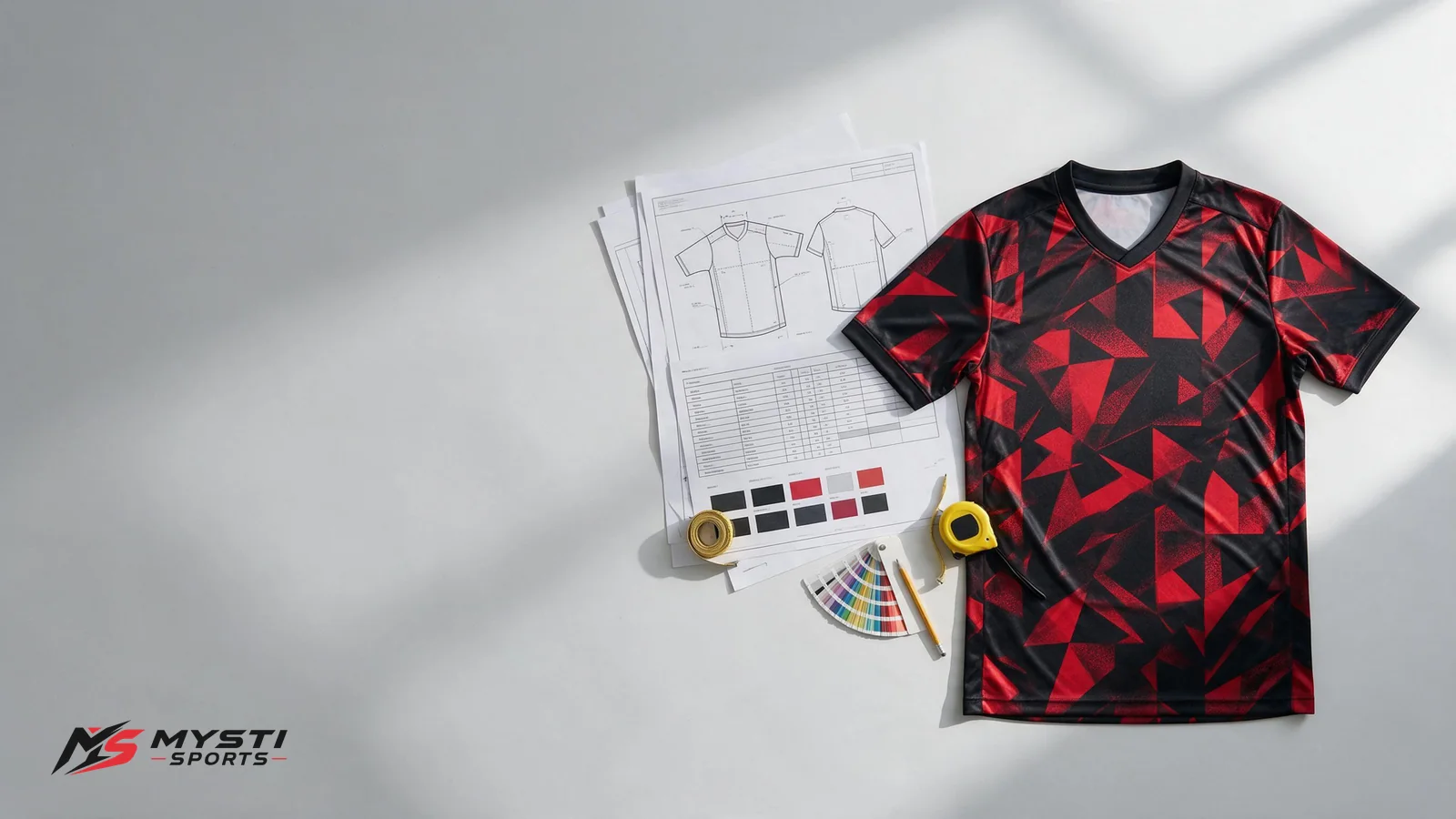
Ask any sportswear factory for a quote and the first thing they will ask for is your tech pack. Plenty of new brands, clubs and coaches don’t have one yet. That’s usually where things slow down: the quote takes longer, the first sample comes back a little off, and the delivery date moves. A clear tech pack for clothing fixes most of that, because it tells the factory exactly what to make before anyone cuts a single panel.
Most guides on this topic are written for fashion. This one is written for jerseys, leggings, rash guards and team kits. We’ll go through the eight sections every tech pack needs, the extra details sportswear needs on top, a worked example, and a free template you can download at the end. It’s one step in our guide to starting a clothing brand.
Quick answer
A tech pack for clothing is a document that tells a factory how to make a garment: flat sketches, measurements with tolerances, materials, colours, construction and labels. A sportswear tech pack also covers print artwork for each panel, fabric performance such as stretch and weight, and where names, numbers and sponsor logos go.
What is a tech pack (and how is it different from a spec sheet)?
A tech pack, short for technical package, is the set of instructions a manufacturer uses to price, sample and produce your garment. Think of it as the reference both sides agree on. If a sample doesn’t look the way you expected, the tech pack is the first thing you and the factory open.
You’ll often hear “tech pack” and “spec sheet” used as if they were the same thing. They overlap, but they do different jobs:
| Document | What it contains | Good enough for |
|---|---|---|
| Design sketch | A drawing or mock-up of how the garment should look | Early ideas and a rough first price |
| Spec sheet | Measurements for each size, sometimes with fabric notes | Re-orders of a style the factory has already made |
| Tech pack | Flats, measurements, materials, construction, artwork, labels, packing and a revision log | A new style, a first sample and bulk production |
So a spec sheet is really one page of a tech pack. For a brand-new product, you want the whole thing.
The 8 sections every clothing tech pack needs
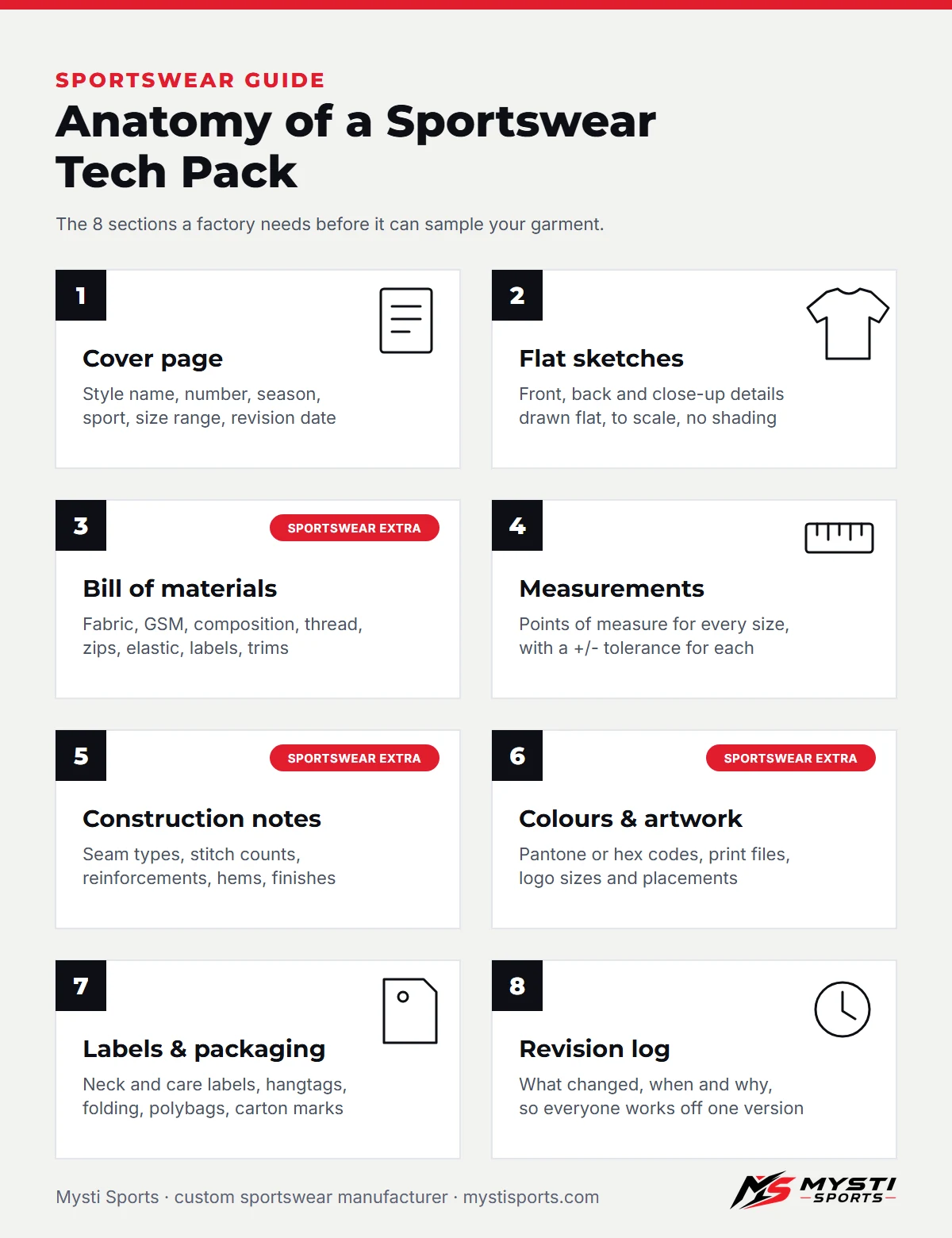
It doesn’t matter whether you’re making a football shirt, a pair of leggings or a hoodie. A complete tech pack covers the same eight areas. Give each one its own page or a clearly marked block so the cutting room, print room and sewing line can each find their part without reading the whole file.
1. Cover page
Brand or team name, style name and number, season, sport and product, size range, quantity, delivery date, a contact person and the current revision number. This is how everyone knows they’re looking at the latest version.
2. Flat sketches
Front and back views drawn flat and to scale. No shading, no model poses. Add close-ups for anything unusual, like a zip garage, a gusset, a silicone gripper or a hidden key pocket. Arrows and short labels work much better than long paragraphs here.
3. Bill of materials (BOM)
Every material and trim the factory needs to buy. That means the main fabric with its composition and weight in GSM, any mesh or contrast panels, rib, elastic, thread, zips, buttons, drawcords, labels and hangtags, each with a colour and a placement.
4. Measurements and tolerances
A table of points of measure (chest, length, sleeve, waist, inseam and so on) for every size, plus a tolerance for each one, such as ±1 cm on chest width. Without tolerances nobody can say whether a sample has passed or failed.
5. Construction notes
How each part is sewn: seam types, stitch types, hem finishes, which seams are taped or reinforced, and how the neck and cuffs are finished.
6. Colours and artwork
Colour references as Pantone or hex codes, your print and embroidery files, the decoration method for each logo, and its exact size and position.
7. Labels and packaging
Neck label type and position, care and size labels, hangtags, how each garment is folded, whether it gets its own polybag, and any carton markings.
8. Revision log
A dated list of what changed between versions and who signed it off. It feels like paperwork, but it’s what stops an old measurement from sneaking back into bulk production.
What a sportswear tech pack needs on top
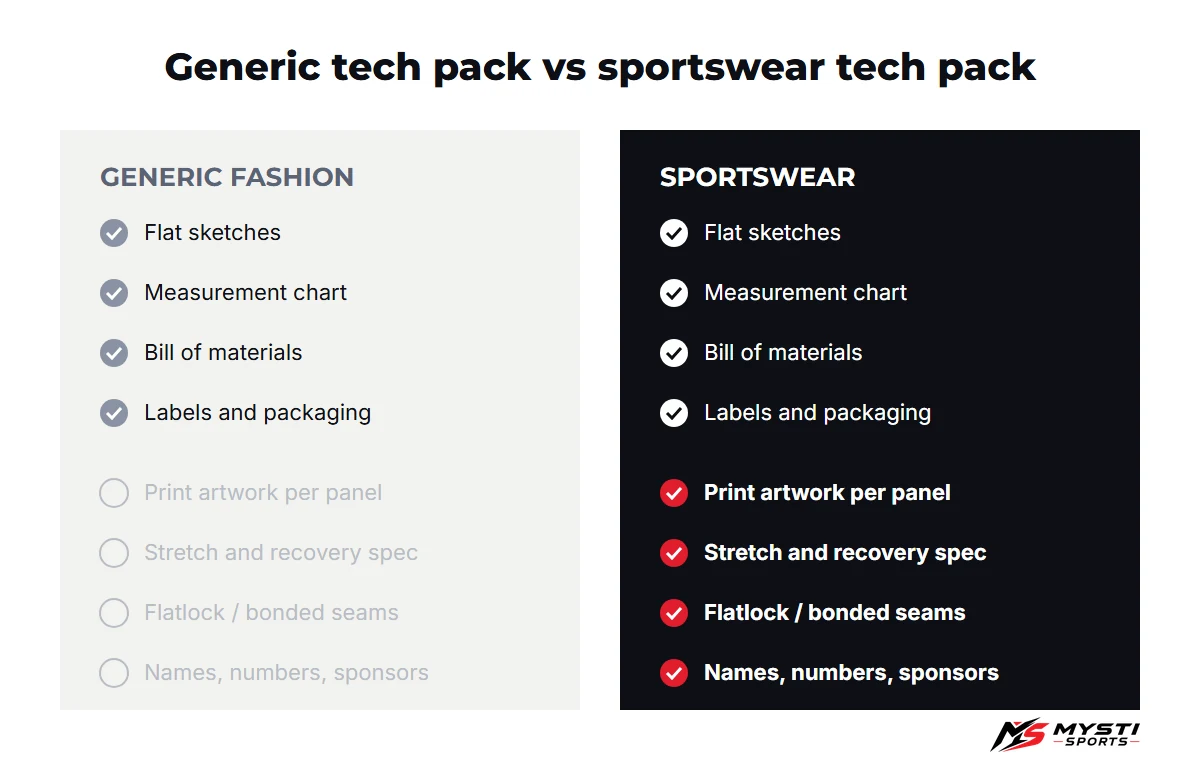
Most tech pack guides stop at those eight sections because they were written with dresses, denim and plain t-shirts in mind. Performance and team wear is a different job. Panels are printed before they’re sewn. Fabrics stretch. Seams sit against skin through a full training session. And a team kit might carry a different name and number on every single shirt. These are the details that decide whether a sublimated jersey or a pair of compression leggings comes back right first time.
Sublimation artwork: one file per panel
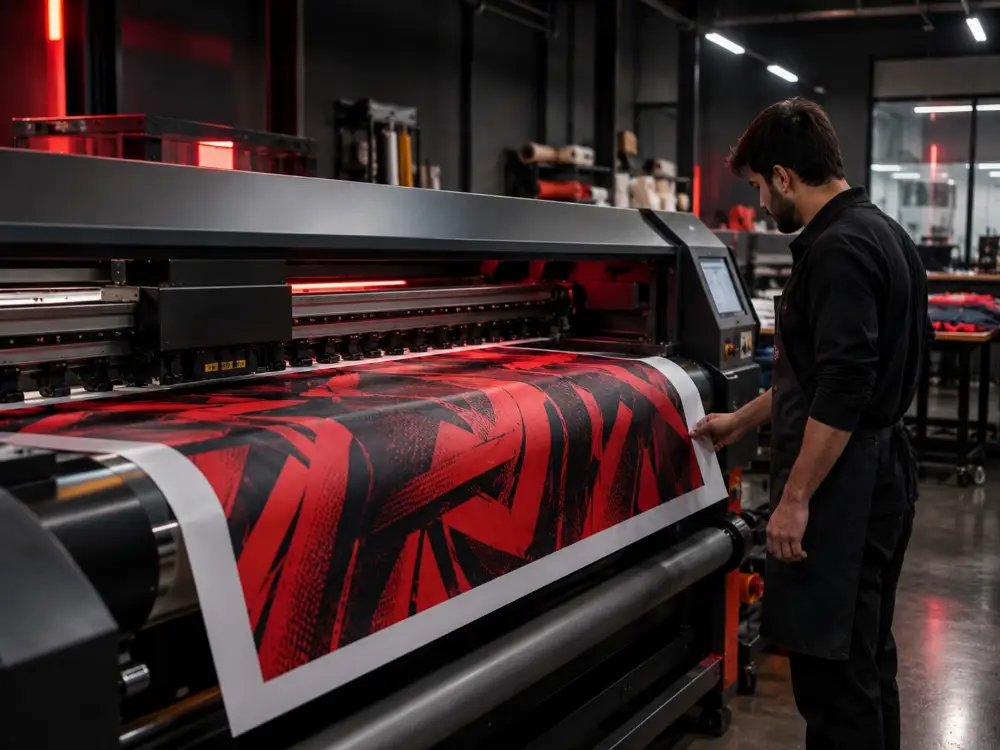
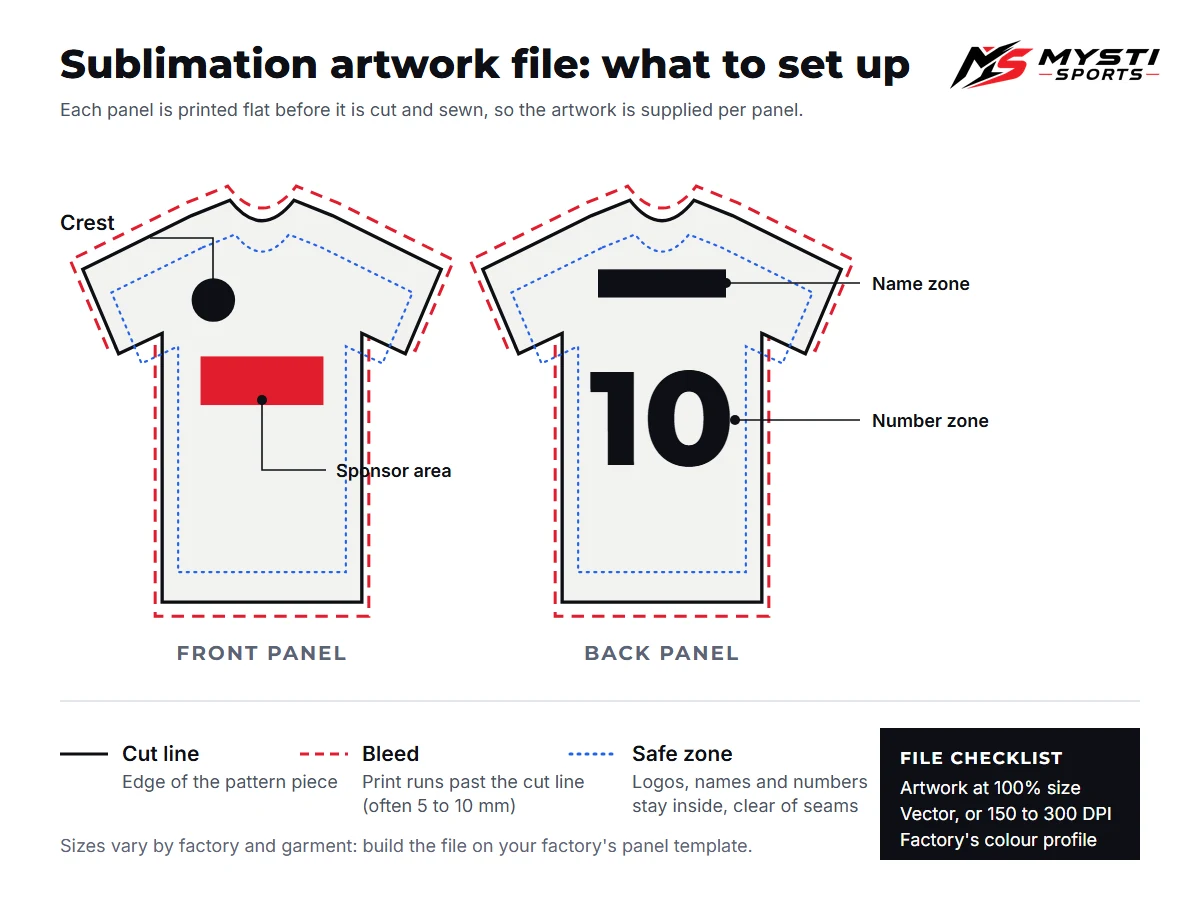
With dye sublimation, the design goes onto the fabric while it’s still flat. The panels are cut and sewn afterwards. So your artwork isn’t one picture of the finished shirt. It’s a set of files, one for each pattern piece: front, back, both sleeves, and sometimes the collar and side panels.
- Use the factory’s panel template. Ask for the pattern pieces for your exact style and sizes, then build the artwork on top of them.
- Add bleed. Run the print past the cut line, usually by around 5 to 10 mm, so a small shift during cutting never leaves a white edge.
- Keep a safe zone. Crests, sponsor logos, names and numbers should stay clear of seams and edges, where they can be cut through or folded into a seam.
- Send print-ready files. Artwork at full size, either as vectors or as high-resolution images (150 to 300 DPI at 100%), with fonts outlined and colours set up for the factory’s colour profile.
- Say where patterns must line up. If a design flows from the front onto the sleeve, mark where the lines have to meet.
Performance fabric: describe how it should behave
“Black polyester” isn’t a fabric spec. For sportswear, write down:
- The composition, for example 88% polyester and 12% elastane
- The weight in GSM and the type of knit or weave (interlock, mesh, piqué, ripstop)
- Whether it’s 2-way or 4-way stretch, and how well it should recover
- Any finishes, such as moisture wicking, quick dry or anti-odour
- Where mesh or ventilation goes, for example under the arms or across the back
- A shrinkage allowance, especially for cotton-rich training wear
Got a garment whose fabric you already love? Send it to us as a reference. It’s the quickest way to agree on a fabric.
Seams and construction for movement
Seams are usually the first thing to fail on performance wear, so name the seam type for each area. Flatlock seams suit compression and base layers, where comfort against skin matters most. Overlock is standard for most jerseys. Bonded or taped edges give a clean, low-profile finish. Then mark the stress points that need reinforcing, like the crotch gusset on fight shorts, bar-tacks on pocket corners or taped shoulders on heavier tops.
Sizing and grading with all-over prints
When a garment is graded from S up to 3XL, the panels get bigger. A full-coverage print has to be scaled or extended to fit every size, but your logos usually shouldn’t grow with it. Say in the tech pack whether the artwork scales with the size or stays fixed. If needed, give logo sizes per size group, for example a 7 cm crest on youth sizes and 9 cm on adult sizes.
Names, numbers, crests and sponsors
A team order is really lots of small variations on one garment. Include a names and numbers list with a size next to each player, the font for names and numbers, their height in cm, and where they sit (for example, numbers 25 cm tall on the back, 8 cm below the name). Add each sponsor’s position, how it’s applied (sublimated, embroidered or heat transfer) and whether youth kits carry different sponsors.
Tech pack example: a tennis polo, page by page
Here’s how the sections fit together on one sheet. The example is a simple performance tennis polo, and the red numbers match the eight sections above.
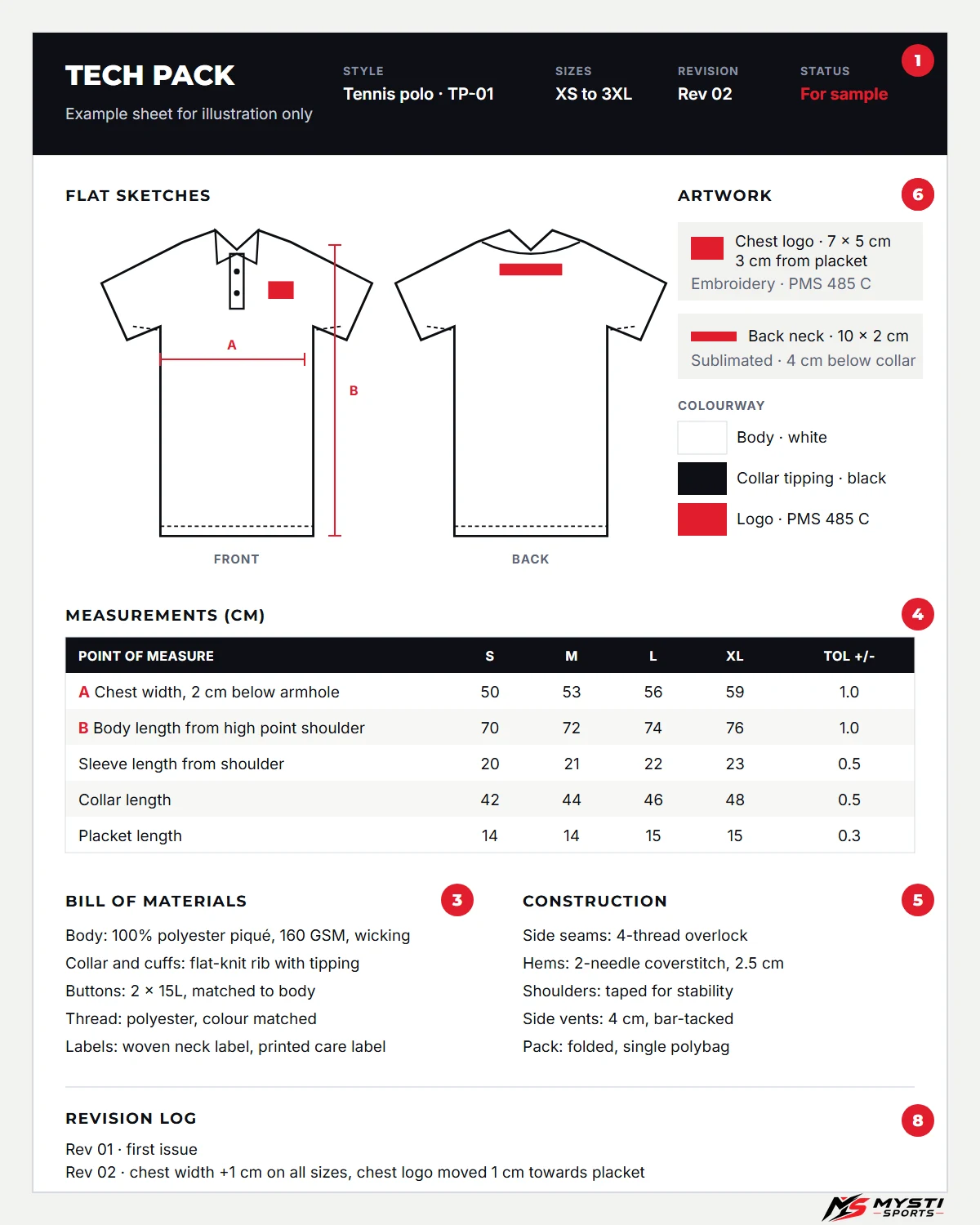
- Cover strip (1): style name and number, size range, revision and status, so nobody samples from an old version.
- Flats (2): front and back views, with the two key measurements marked A and B right on the sketch.
- Bill of materials (3): piqué body fabric with its GSM, a flat-knit collar with tipping, buttons, thread and labels.
- Measurements (4): points of measure for each size, each with its own tolerance. A and B link the table back to the sketch.
- Construction (5): seam and hem types, taped shoulders, bar-tacked side vents and how the polo is packed.
- Artwork (6): logo size, its distance from the placket, the method and the Pantone reference, plus the colourway.
- Revision log (8): exactly what changed after the first fit check, so the next sample starts from the right numbers.
On a one-page sheet like this, labels and packaging (7) sit inside the materials and construction blocks. On a bigger style they get a page of their own.
Tech pack add-ons by sport
Every sport has a few details that are easy to forget. Add these to your tech pack depending on what you’re making:
| Sport | Add to your tech pack |
|---|---|
| Football (soccer) jerseys | Names and numbers list, sponsor zones, sleeve badges, collar style, matching shorts and socks |
| Cricket | Whites or coloured kit, collar and placket, your league’s sponsor rules, trouser length by size |
| BJJ and MMA | Gi weave and weight, reinforced stress points, patch positions, how tight the rash guard should be |
| Cycling jerseys | Rear pocket depth, zip length, silicone gripper width, reflective details, chamois for bib shorts |
| Gym and leggings | Squat-proof opacity, waistband height and build, gusset, flatlock seams, pocket placement |
| Motorcycle gear | Armour pocket positions, abrasion panels, stretch zones, and safety labels for the standard you need |
7 tech pack mistakes that cause sample rejections
- No tolerances. Without a ± figure, nobody can tell whether 1 cm out is fine or a fail.
- No colour references. “Navy” means something different to every supplier. Give Pantone or hex codes, or post a physical swatch.
- A vague fabric description. “Breathable polyester” leaves the weight, stretch and feel to chance.
- Artwork with no placement. A logo file isn’t a placement. Give the size and the distance from a fixed point such as the centre front or the shoulder seam.
- No grading rules. If you only give measurements for a medium, the factory has to guess the rest.
- No label positions. Say where the neck, care and size labels go, especially on tagless or sublimated garments.
- No version control. Two files both called “final” is how an old measurement ends up in bulk. Number your revisions and keep the log.
No tech pack? Here’s what to send us instead
You don’t need a finished tech pack to start working with Mysti Sports. If you haven’t got one, we’ll put it together for you and send it over for approval before anything is made. All we need is:
- A reference photo, or a garment whose fit and feel you like
- A rough sketch of the style and any details, even if it’s on paper
- Your logo as a vector file (AI, EPS, PDF or SVG) or a high-resolution PNG
- Your colours as Pantone or hex codes
- Your size range and a rough idea of quantities
Our minimum order is 30 to 50 pieces per design, so you can start small and build from there. When you’re ready, get a quote and attach whatever you have.
From tech pack to sample to bulk
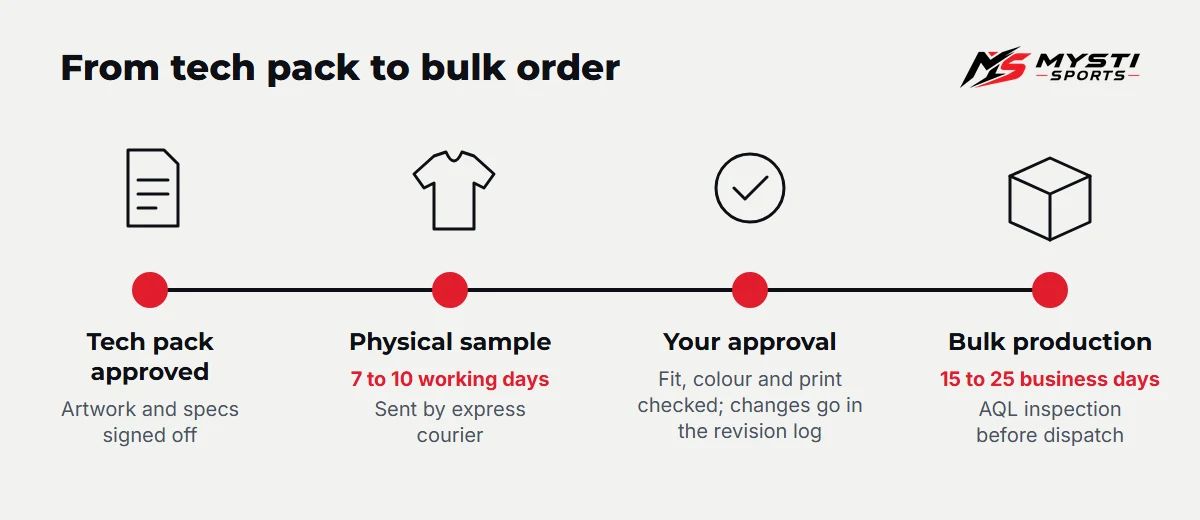
Once your tech pack and artwork are signed off, we make a physical pre-production sample in your actual fabric, cut, print and branding. Samples usually take 7 to 10 working days and go out by express courier, so you can check the fit, colour and print in your hands. Any changes go into the revision log. After you approve the sample, standard bulk production takes 15 to 25 business days depending on volume and complexity, and every order goes through AQL inspection before it ships.
Free sportswear tech pack template
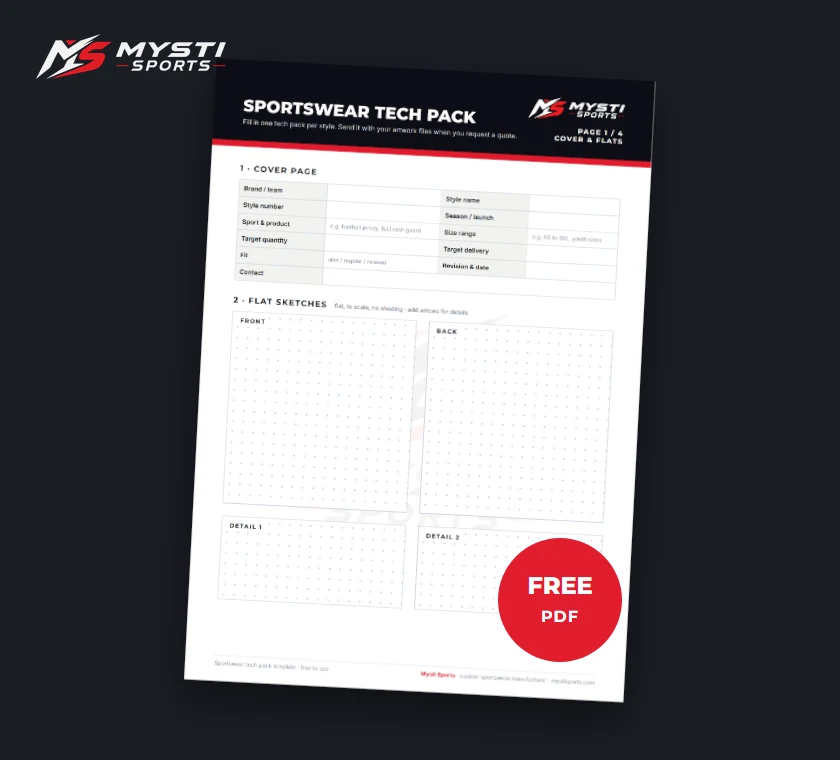
Our free template is a 4-page printable PDF that follows this guide. It has a cover page, sketch boxes, a measurement chart from XS to 3XL with tolerances, a bill of materials, construction notes, artwork and colours, a names and numbers list, labels and packaging, and a revision log.
Sportswear Tech Pack Template
Print it and fill it in by hand, or use it as a checklist for your own file. Then send it with your artwork when you ask for a quote.
Open the free PDFFree · 4 pages · A4 · no sign-up
Frequently asked questions
How long does it take to make a tech pack?
It depends on the garment. A polo with one logo is quick to put together. A sublimated team kit with several panels, sponsors and a names and numbers list takes longer, because every panel needs its own artwork. If we prepare the tech pack for you, we send it over for approval before sampling starts.
Do I need a tech pack for a small order?
Yes. Even a run of 30 to 50 pieces needs clear measurements, materials and logo placement, otherwise the sample is a guess. You don’t have to write it yourself, though. Send us a sketch, a few reference photos and your logo, and we’ll prepare the tech pack for you to approve.
What is the difference between a tech pack and a spec sheet?
A spec sheet is usually just the measurement chart for each size, sometimes with a few fabric notes. A tech pack is the full set of instructions: sketches, measurements with tolerances, materials, construction, colours and artwork, labels, packaging and a revision log. The spec sheet is one page of it.
Can a factory make my tech pack for me?
Many can, and at Mysti Sports it’s part of how we work. Send us a sketch or a reference garment, your logo files, colours and size range. We’ll prepare the tech pack with fabric details, measurements and construction notes, and you approve it before anything is made.
What file format should I send my tech pack and artwork in?
Send the tech pack as a PDF, plus the editable spreadsheet if you have one. Logos work best as vector files (AI, EPS, PDF or SVG) or a high-resolution PNG. For sublimation, send artwork for each panel at full size, built on the factory’s panel template, with the fonts outlined.
What does a sublimated jersey need that a normal tech pack does not?
Artwork for each panel with bleed and a safe zone, colours set up for the factory’s colour profile, rules for how the print scales across sizes, and exact positions for crests, sponsors, names and numbers. If every shirt is personalised, it also needs a names and numbers list matched to sizes.
Ready to turn your idea into a sample? Request a quote with your tech pack, or send us a sketch and a few reference photos and we’ll build the tech pack with you. You can also browse our full product range or read our factory FAQs.
Ready to make your first sample?
Send us your tech pack, or just a sketch and your logo. We prepare the tech pack for your approval, then make a physical sample before bulk.
More guides
Manufacturing Guides
How to Start a Clothing Brand: A Sportswear Founder’s Guide From the Factory Floor
How to start your own clothing brand in sportswear: the real order of steps, print-on-demand vs a factory, timelines, and the mistakes…
Manufacturing Guides
How Much Does It Cost to Start a Clothing Brand? A Sportswear Budget, Line by Line
A line-by-line budget for launching a sportswear brand: samples, production, shipping, duties, branding, website and launch costs, plus a free planner.

Manufacturing Guides
What Is a Sublimated Jersey? A Factory’s Honest Guide
What a sublimated jersey is, how it’s made on a factory floor, the honest limits, and how it compares with screen printing,…